OpenTls13 1.1.0
See the version list below for details.
dotnet add package OpenTls13 --version 1.1.0
NuGet\Install-Package OpenTls13 -Version 1.1.0
<PackageReference Include="OpenTls13" Version="1.1.0" />
<PackageVersion Include="OpenTls13" Version="1.1.0" />
<PackageReference Include="OpenTls13" />
paket add OpenTls13 --version 1.1.0
#r "nuget: OpenTls13, 1.1.0"
#:package OpenTls13@1.1.0
#addin nuget:?package=OpenTls13&version=1.1.0
#tool nuget:?package=OpenTls13&version=1.1.0
TLSServer
A complete TLS 1.3 implementation in pure C# targeting .NET 9.0. Every cryptographic primitive runs through managed code — no BCrypt / OpenSSL P/Invoke. The published binary has a single bcrypt.dll import (BCryptGenRandom) which serves as the OS entropy source; everything else — hashes, HMACs, AEADs, EC point arithmetic, signatures — is pure C#. AES-NI is used via JIT-emitted CPU intrinsics (not a P/Invoke, gated by Aes.IsSupported), so the workhorse cipher stays hardware-fast while remaining portable to non-x86 CPUs.
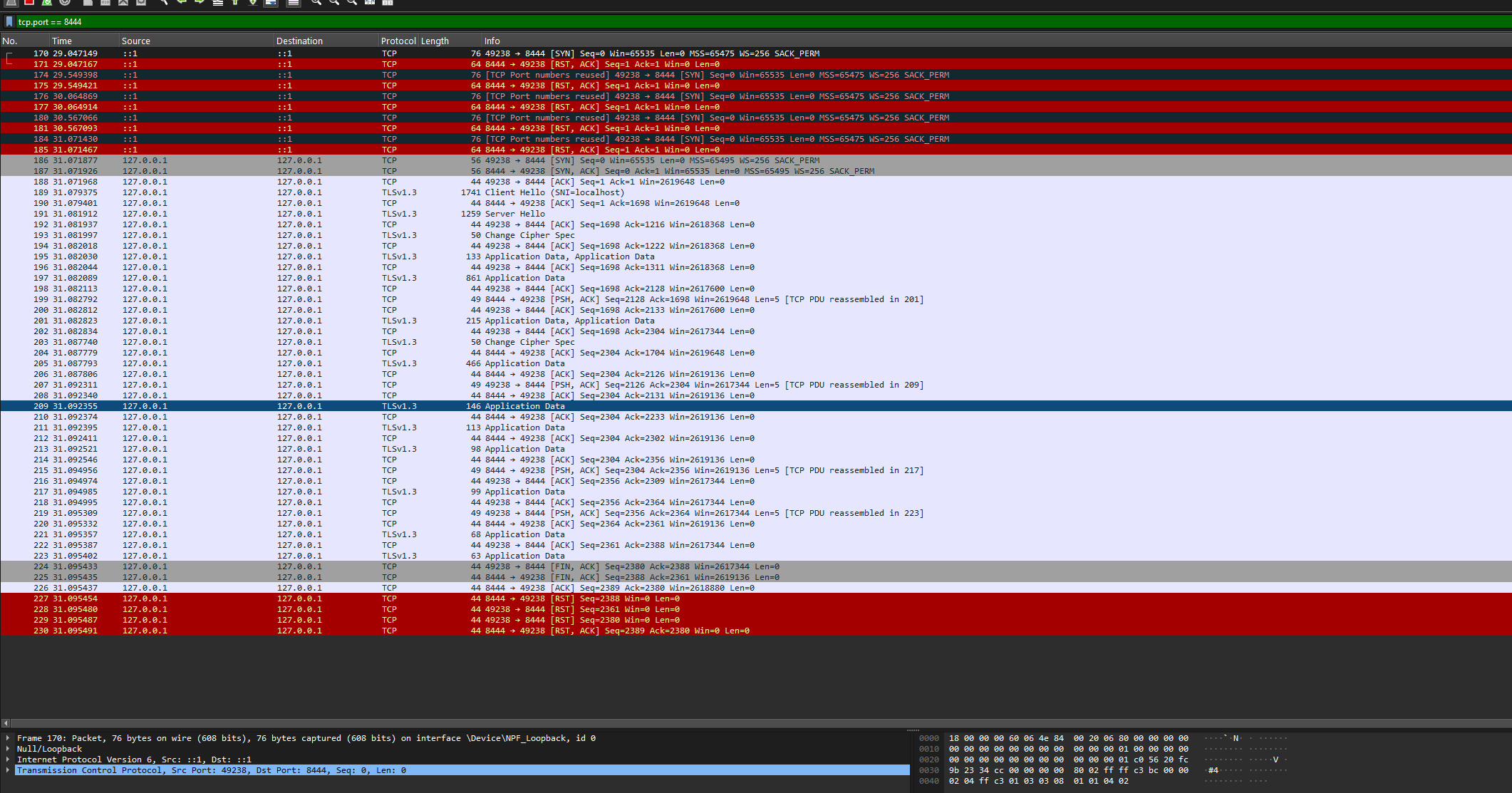
A loopback session captured in Wireshark — the full TLS 1.3 handshake (ClientHello → ServerHello → ChangeCipherSpec → encrypted Application Data) is recognised as TLSv1.3 on the wire. The red ::1 RST rows at the top are the client's IPv6-first connection attempt against the v4-only demo listener (it then falls back to 127.0.0.1); see the performance note below.
**Note 1 😗* AI driven prompt project.
**Note 2 😗* a packable library project lives in
OpenTls13/—dotnet pack -c Release OpenTls13/OpenTls13.csprojproduces the.nupkg(multi-targets net8.0 / net9.0 / net10.0, AGPL-3.0-or-later, zero transitive dependencies). See NuGet package below.
**Note 3 😗* national-crypto suites (GOST, Chinese SM) are KAT-verified against published standard vectors and pass self-interop (this client ↔ this server), but have not yet been cross-validated against external stacks (GmSSL / OpenSSL-GOST). See Limitations.
Features
Protocol
- Full TLS 1.3 (RFC 8446) handshake — client and server, sync + async
- Mutual TLS (mTLS) with client certificate authentication
- PSK session resumption with NewSessionTicket
- 0-RTT early data
- Post-handshake key update (RFC 8446 §4.6.3) with usage-limit automation
- Post-handshake client authentication
- HelloRetryRequest with cookie support
- ALPN negotiation
- OCSP stapling (status_request)
- Encrypted Client Hello (ECH, RFC 9849) + HPKE (RFC 9180)
- GREASE (RFC 8701)
- record_size_limit negotiation (RFC 8449)
- Downgrade-protection sentinel check (RFC 8446 §4.1.3)
- Middlebox compatibility mode (ChangeCipherSpec)
- SSLKEYLOGFILE logging (Wireshark-compatible NSS Key Log Format)
Cryptography
| Category | Algorithms |
|---|---|
| Key Exchange | X25519, X448, ECDH P-256, ECDH P-384, X25519MLKEM768 (hybrid post-quantum), GOST curves (GC256A–D / GC512A–C), curveSM2 |
| Signatures | ECDSA P-256/SHA-256, ECDSA P-384/SHA-384, Ed25519, RSA-PSS, RSA-PKCS#1 (legacy), GOST R 34.10-2012 (256/512), SM2 |
| AEAD Ciphers | AES-128-GCM, AES-256-GCM, ChaCha20-Poly1305, Kuznyechik-MGM, Magma-MGM, SM4-GCM, SM4-CCM |
| Hash / KDF | SHA-256/384/512, HKDF (RFC 5869), Streebog-256/512, SM3, HMAC variants |
| Post-Quantum | ML-KEM-768 (FIPS 203) with NTT-based polynomial arithmetic |
| Keccak Sponge | SHA3-256, SHA3-512, SHAKE-128, SHAKE-256 (pure managed) |
| National | GOST R 34.11/34.12/34.13-2015 (RFC 9367), Chinese SM2/SM3/SM4 (RFC 8998) |
| Certificates | X.509 v3 generation (incl. GOST / SM2 certs), CA chaining, PKCS#12/PFX, PKCS#7 |
| Compression | Certificate compression (RFC 8879) via Brotli and Zstandard |
Symmetric primitives (AES-GCM, SHA-2 family, HMAC) and the asymmetric handshake primitives (RSA, NIST P-256/P-384/P-521 ECDSA/ECDH, X25519, X448) go through BouncyCastle's vendored pure-managed implementations — no System.Security.Cryptography.* runtime calls into BCrypt or OpenSSL. The NIST EC paths use BouncyCastle's optimized Custom*Curve classes (CustomNamedCurves) and X25519/X448 use its Rfc7748 packed-limb implementations — both far lighter on allocations than a generic System.Numerics.BigInteger ladder. ChaCha20-Poly1305 is a hand-written RFC 8439 implementation. The ML-KEM-768 NTT/InvNTT, Ed25519, SM2/SM3/SM4, and Keccak are implemented from scratch. GOST primitives are vendored from OpenGost, with EC scalar-mult on Jacobian projective coordinates (one modular inverse per scalar mult instead of one per point operation).
Cipher suites
| Suite | Spec |
|---|---|
| TLS_AES_128_GCM_SHA256, TLS_AES_256_GCM_SHA384, TLS_CHACHA20_POLY1305_SHA256 | RFC 8446 |
| TLS_GOSTR341112_256_WITH_KUZNYECHIK_MGM_L / _S | RFC 9367 |
| TLS_GOSTR341112_256_WITH_MAGMA_MGM_L / _S | RFC 9367 |
| TLS_SM4_GCM_SM3, TLS_SM4_CCM_SM3 | RFC 8998 |
Vendored sources (MIT / BSD / Apache 2.0)
- BouncyCastle (bc-csharp) — AES + GCM mode, SHA-2 digests, HMAC, RSA, NIST EC curves, BigInteger, ASN.1 (
TLS/BouncyCastle/, ~1330 files) - BrotliSharpLib — Brotli for RFC 8879 cert compression, replaces
System.IO.Compression.BrotliStream(TLS/BrotliSharp/, 58 files) - ZstdSharp — Zstandard for RFC 8879 cert compression (
TLS/Zstd/) - OpenGost — GOST Kuznyechik / Magma block ciphers, Streebog hash, GOST R 34.10-2012 (
TLS/OpenGost/, ~18 files; the upstreamHashAlgorithm/SymmetricAlgorithm/ECDsabase-class inheritance has been stripped so the BCL crypto registry — and its BCrypt imports — don't get linked)
Architecture
Open-TLS1.3.sln
├── TLS/                    # Shared project — core TLS library
│   ├── TlsConnection.cs    # Handshake state machine (sync + async)
│   ├── RecordLayer.cs      # Record framing, AEAD encryption, fragmentation
│   ├── KeySchedule.cs      # TLS 1.3 key schedule (RFC 8446 §7)
│   ├── Hkdf.cs             # HKDF + HKDF-Expand-Label (multi-hash)
│   ├── AeadCipher.cs       # AES-GCM / ChaCha20 / MGM / SM4-GCM/CCM dispatch
│   ├── AesGcmManaged.cs    # AES-GCM via BC AesEngine + GcmBlockCipher (cached per instance)
│   ├── ChaCha20.cs / Poly1305.cs / ChaCha20Poly1305Managed.cs  # RFC 8439 from scratch
│   ├── Sha2Managed.cs      # SHA-2 / HMAC-SHA wrappers over BC digests (IncrementalSha2 for transcript)
│   ├── RsaManaged.cs / EcdsaManaged.cs  # BC RSA / NIST EC wrappers
│   ├── Ed25519.cs / X25519.cs / X448.cs / EcdhP256.cs / EcdhP384.cs
│   ├── MlKem768.cs         # FIPS 203 ML-KEM-768
│   ├── Keccak.cs           # Keccak-f[1600] sponge (SHA3/SHAKE)
│   ├── Hpke.cs             # HPKE (RFC 9180)
│   ├── EncryptedClientHello.cs  # ECH (RFC 9849)
│   ├── Mgm.cs              # GOST MGM AEAD (RFC 9058/9367), packed-ulong GF(2^128)
│   ├── GostCrypto.cs / GostKdf.cs / GostEcdh.cs  # GOST facade, Streebog KDF, GOST ECDH
│   ├── OpenGost/           # Vendored GOST + Jacobian EC scalar-mult
│   ├── ChineseCrypto.cs    # SM2 / SM3 / SM4 (SM2 EC math = Jacobian projective)
│   ├── Sm4Aead.cs / Sm3Kdf.cs   # SM4-GCM/CCM AEAD, SM3 KDF
│   ├── Grease.cs           # GREASE (RFC 8701)
│   ├── CertificateUtils.cs # X.509 generation (incl. GOST/SM2), CA chaining
│   ├── Asn1.cs / Pkcs12.cs / Pkcs7.cs   # DER, PFX, PKCS#7
│   ├── SessionTicket.cs / KeyLogger.cs / CertificateCompression.cs
│   ├── BouncyCastle/       # Vendored BC core (crypto, math, security, util, asn1)
│   ├── BrotliSharp/        # Vendored Brotli for RFC 8879
│   └── Zstd/               # Vendored Zstandard for RFC 8879
├── TLSServer/  TLSClient/  TLSServerAsync/  TLSClientAsync/   # demo apps
└── Tests/                  # Test-vector + loopback suite (dependency-free)
Quick Start
Prerequisites
Build
dotnet build Open-TLS1.3.sln
Run
Start the server (listens on port 8443 with mTLS):
dotnet run --project TLSServer
Connect with the client:
dotnet run --project TLSClient
For async variants:
dotnet run --project TLSServerAsync
# In another terminal:
dotnet run --project TLSClientAsync
The server auto-generates a CA and server certificate at startup and exports client.pfx for mTLS client authentication.
Selecting national cipher suites (client)
var client = new TlsClient
{
    CipherSuites = new[] { CipherSuite.TLS_GOSTR341112_256_WITH_KUZNYECHIK_MGM_L },
    NamedGroups  = new[] { NamedGroup.GC256A }   // GOST-curve key exchange
};
// server side: var cert = CertificateUtils.IssueGostCertificate("host", ca, CertificateProfile.Server, SignatureScheme.Gostr34102012_256a);
//              or            CertificateUtils.IssueSm2Certificate("host", ca, CertificateProfile.Server);
Wireshark Decryption
Set the SSLKEYLOGFILE environment variable before running the server or client to enable key logging:
export SSLKEYLOGFILE=~/keys.log
dotnet run --project TLSServer
Then point Wireshark to the key log file under Preferences > Protocols > TLS > (Pre)-Master-Secret log filename.
Tests
A dependency-free test suite lives in Tests/ (known-answer vectors + end-to-end loopback matrix).
dotnet run -c Release --project Tests           # all tests (83 KAT + loopback + record-layer + wire-format round-trips)
dotnet run -c Release --project Tests bench     # AEAD throughput + handshake + bulk-transfer benchmarks
dotnet run -c Release --project Tests profile   # per-phase allocation breakdown of one handshake per suite
dotnet run -c Release --project Tests bulk      # 20 MB + 50 MB bulk loopback (AES-128/256-GCM + ChaCha20)
dotnet run -c Release --project Tests fuzz      # parser fuzz harness (120k inputs across 12 parsers)
dotnet run -c Release --project Tests fuzz 50000  # heavier fuzz (~600k inputs)
Coverage includes KATs vs published vectors (MGM RFC 9058, SM4/SM3 GB/T, SM4-GCM/CCM RFC 8998, Streebog, GOST R 34.10-2012 and SM2 signatures, HKDF RFC 5869, X25519 RFC 7748, ChaCha20 / Poly1305 / AEAD-ChaCha20-Poly1305 RFC 8439) and full handshake+data loopbacks for every cipher suite plus mTLS plus RFC 8879 cert compression.
Measured performance (loopback, single-thread, this dev box)
Bulk data throughput (50 MB, end-to-end through TLS record framing):
| Cipher | Throughput |
|---|---|
| AES-128-GCM | ~90–100 MB/s |
| AES-256-GCM | ~90–100 MB/s |
| ChaCha20-Poly1305 (managed RFC 8439) | ~85–95 MB/s |
Full TLS 1.3 handshake (loopback, after the allocation overhaul — see changelog.txt):
| Suite | Latency | Allocation / handshake |
|---|---|---|
| default (X25519 + AES-256-GCM + ECDSA P-256 cert) | ~5–7 ms | ~1.05 MB |
| GOST (Kuznyechik-MGM + GC256A + GOST cert) | ~14 ms | ~6.4 MB |
| SM (SM4-GCM + curveSM2 + SM2 cert) | ~13 ms | ~7.3 MB |
Earlier revisions of this table reported ~2 s GOST/SM handshakes — that was an IPv6 loopback-fallback artifact in the benchmark (the client resolved
localhostto::1first, where the v4-only listener refused it, then fell back to v4 after ~2 s of SYN→RST backoff). The benchmark now connects to127.0.0.1directly. National-suite latency is dominated by theirSystem.Numerics.BigInteger-based EC scalar multiplication; the default suite uses BouncyCastle's optimized curve paths. Bulk throughput is cipher-bound, not allocation-bound, so it is unchanged by the allocation work — that work cut per-handshake allocation ~10× and per-record bulk allocation ~14× (seechangelog.txtfor the before/after numbers).
Native AOT
All projects are configured for native AOT compilation:
dotnet publish -c Release --project TLSServer
NuGet package
The core library ships as a packable class library in OpenTls13/ that compiles the
shared TLS/ sources (plus the vendored BouncyCastle / BrotliSharpLib / ZstdSharp /
OpenGost) into a single OpenTls13.dll — zero transitive NuGet dependencies.
dotnet pack -c Release OpenTls13/OpenTls13.csproj
# → OpenTls13/bin/Release/OpenTls13.<version>.nupkg  (+ .snupkg symbols)
- Package id:
OpenTls13· License:AGPL-3.0-or-later· Targets: net8.0 / net9.0 / net10.0 - AOT-friendly (the demo apps publish with
PublishAot=true), thoughIsAotCompatibleis intentionally left off the library to avoid analyzer noise from the vendored crypto. - Consume it with only the public API (
TlsServer,TlsClient,TlsStream,CertificateUtils,CipherSuite,NamedGroup, …):
using TLS;
var ca   = CertificateUtils.GenerateCA("My CA");
var cert = CertificateUtils.IssueCertificate("localhost", ca, CertificateProfile.Server);
var server = new TlsServer(cert);
server.Listen(8443);
using var s = server.Accept();          // TlsStream — Read/Write encrypted app data
AGPL note: AGPL-3.0 is strong copyleft — network use of a derivative obliges source disclosure. The vendored crypto stays under its original permissive MIT / Bouncy Castle terms (see
OpenTls13/THIRD-PARTY-NOTICES.txt); only the OpenTls13 code as a whole is AGPL. If you need a non-copyleft option, dual-licensing is the author's call.
RFC Compliance
Core TLS 1.3 (RFC 8446) is compliant — handshake, HelloRetryRequest + cookie, middlebox-compat, 0-RTT, KeyUpdate, post-handshake auth, alerts, and downgrade-sentinel checking.
| Specification | Coverage |
|---|---|
| RFC 8446 | TLS 1.3 protocol, handshake, record layer, key schedule |
| RFC 8701 | GREASE |
| RFC 8449 | record_size_limit |
| RFC 7748 | X25519 and X448 Diffie-Hellman |
| RFC 8032 | Ed25519 signatures |
| RFC 5869 | HKDF key derivation |
| RFC 8879 | Certificate compression (Brotli, Zstandard) |
| RFC 8937 | Randomness wrapper |
| RFC 9149 | Ticket request extension |
| RFC 9258 | External PSK importer |
| RFC 9261 | Exported authenticators |
| RFC 9266 | TLS channel binding |
| RFC 9963 | Legacy RSA PKCS#1 signature schemes (cert verification) |
| RFC 9180 | HPKE (Hybrid Public Key Encryption) |
| RFC 9849 | Encrypted Client Hello (ECH) |
| RFC 9367 / 9058 | GOST cipher suites (Kuznyechik/Magma MGM, Streebog, GOST R 34.10-2012, GOST curves) |
| RFC 8998 | Chinese SM cipher suites (SM4-GCM/CCM, SM3, SM2, curveSM2) |
| FIPS 203 | ML-KEM-768 (Module-Lattice Key Encapsulation) |
| draft-ietf-tls-ecdhe-mlkem | X25519MLKEM768 hybrid key exchange |
Limitations
- External interop is unverified. This stack passes its own loopback matrix end-to-end (and 120 k+ fuzz inputs across all message parsers without unhandled exceptions), but has not been cross-tested against OpenSSL, BoringSSL, nginx, curl, GmSSL, or OpenSSL-GOST. Production use should validate against the target peer first. In particular, this stack emits Streebog digests in the reverse byte order of RFC 6986's textual presentation, and the GOST/SM CertificateVerify hashing is internally self-consistent — byte-order conventions should be validated before relying on external national-suite interop.
- National AEAD throughput is bound by the managed implementation. Hardware-accelerated AES-GCM does ~100 MB/s end-to-end through TLS framing; managed Kuznyechik / Magma / SM4 are an order of magnitude slower (tens of MB/s) and dominated by their per-block cost. GOST and SM2 scalar-mult is on Jacobian coordinates (one modular inverse per scalar mult, ~18% faster than the previous affine implementation).
- The on-wire ClientHello
signature_algorithms/supported_groupsadvertise the standard set only; national schemes/curves work in self-interop because the server selects directly. max_fragment_length(RFC 6066) is intentionally not sent (superseded byrecord_size_limit).- TLS 1.2 fallback is out of scope by design — this is a TLS-1.3-only stack.
| Product | Versions Compatible and additional computed target framework versions. |
|---|---|
| .NET | net8.0 is compatible. net8.0-android was computed. net8.0-browser was computed. net8.0-ios was computed. net8.0-maccatalyst was computed. net8.0-macos was computed. net8.0-tvos was computed. net8.0-windows was computed. net9.0 is compatible. net9.0-android was computed. net9.0-browser was computed. net9.0-ios was computed. net9.0-maccatalyst was computed. net9.0-macos was computed. net9.0-tvos was computed. net9.0-windows was computed. net10.0 is compatible. net10.0-android was computed. net10.0-browser was computed. net10.0-ios was computed. net10.0-maccatalyst was computed. net10.0-macos was computed. net10.0-tvos was computed. net10.0-windows was computed. |
-
net10.0
- No dependencies.
-
net8.0
- No dependencies.
-
net9.0
- No dependencies.
NuGet packages
This package is not used by any NuGet packages.
GitHub repositories
This package is not used by any popular GitHub repositories.