GridForge 9.0.0
dotnet add package GridForge --version 9.0.0
NuGet\Install-Package GridForge -Version 9.0.0
<PackageReference Include="GridForge" Version="9.0.0" />
<PackageVersion Include="GridForge" Version="9.0.0" />
<PackageReference Include="GridForge" />
paket add GridForge --version 9.0.0
#r "nuget: GridForge, 9.0.0"
#:package GridForge@9.0.0
#addin nuget:?package=GridForge&version=9.0.0
#tool nuget:?package=GridForge&version=9.0.0
GridForge
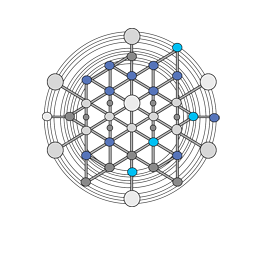





GridForge is a deterministic voxel-world library for building fast spatial systems in games, simulations, tools, and server runtimes.
It gives you the low-level grid infrastructure that many systems end up reinventing: snapped voxel bounds, world-scoped grid registration, conjoined-grid neighbor awareness, scan-cell query overlays, blocker and obstacle state, occupant tracking, and fixed-point spatial math.
The interesting part is the shape of the model. GridForge does not force you
into one giant grid, a hand-managed tile map, or a premature hierarchy. It gives
you an explicit GridWorld that can own one grid, many conjoined grids, or a
streamed set of active grids, while still leaving room for higher-level sector,
region, planet, or shard systems above it.
Why GridForge?
Grid-based systems tend to split into three common approaches:
| Approach | Best fit | Tradeoff |
|---|---|---|
| Single large grid | Small or fixed worlds | Simple, but can become wasteful or awkward to stream |
| Multiple conjoined grids | Large worlds, loaded regions, tiled simulation spaces | More flexible, but needs reliable ownership and neighbor handling |
| Hierarchical grids | Very large or multi-scale worlds | Powerful, but easy to overbuild too early |
GridForge is designed around the most flexible foundation: conjoined grids inside explicit worlds.
That means you can start with a single grid, add neighboring grids as the world grows, remove inactive grids as regions unload, and build hierarchy above the library only when your game or simulation actually needs it.
What It Provides
- Explicit
GridWorldownership for isolated runtime state - Multiple active grids per world, with conjoined boundary neighbor lookup
- Deterministic fixed-point math through
FixedMathSharp - Fast world-space lookup through snapped bounds and an adaptive world index
- Rectangular-prism and hex-prism topology through the same
VoxelGridmodel - Dense and sparse voxel storage behind the same
VoxelGridquery model - Scan-cell overlays for efficient radius and occupant queries
- Region coverage through
GridTracer - Blocker and obstacle workflows for world-space blocked areas
- Occupant and partition extension points for gameplay or simulation metadata
- Engine-agnostic diagnostic cell, geometry, and dirty-change descriptors for tools and overlays
- Allocation-conscious internals built on
SwiftCollectionspools and containers - Standard and lean package variants for different dependency needs
The default SpatialGridCellSize is 50 and remains optional tuning for
ordinary similarly sized grids. Oversized grid footprints are indexed
automatically; hosts should not match this value to the largest streamed grid.
Install
dotnet add package GridForge
GridForge targets netstandard2.1 and net8.0.
Package Variants
GridForge is published in two build variants:
| Package | Use when |
|---|---|
GridForge |
You want the default package with MemoryPack, FixedMathSharp, SwiftCollections, and the fixed-point SwiftCollections query companion. |
GridForge.Lean |
You want the same core voxel-grid API without the direct MemoryPack dependency, using the lean FixedMathSharp and SwiftCollections package family. |
Install the lean package with:
dotnet add package GridForge.Lean
Source builds also expose matching configurations:
Releasebuilds the standardGridForgepackage.ReleaseLeanbuilds theGridForge.Leanpackage.
Unity-specific integration lives in the separate GridForge-Unity repository.
Quick Start
using System;
using FixedMathSharp;
using GridForge.Configuration;
using GridForge.Grids;

using GridWorld world = new GridWorld();

GridConfiguration configuration = new GridConfiguration(
    new Vector3d(-10, 0, -10),
    new Vector3d(10, 0, 10),
    scanCellSize: 8);

if (!world.TryAddGrid(configuration, out ushort gridIndex))
    throw new InvalidOperationException("Failed to add grid.");

VoxelGrid grid = world.ActiveGrids[gridIndex];
Vector3d position = new Vector3d(2, 0, -3);

if (world.TryGetGridAndVoxel(position, out VoxelGrid resolvedGrid, out Voxel voxel))
{
    Console.WriteLine($"Grid: {resolvedGrid.GridIndex}");
    Console.WriteLine($"Voxel: {voxel.Index}");
    Console.WriteLine($"World position: {voxel.WorldPosition}");
}
Use the TryGetClosest... lookup variants when a query should snap to the
nearest grid bounds or nearest physical voxel center instead of requiring the
position to fall inside an existing voxel. Sparse closest-voxel queries only
consider configured physical voxels. In mixed-topology worlds, pass the optional
GridTopologyKind argument to GridWorld closest queries to restrict candidate
grids to rectangular-prism or hex-prism topology.
For flat XZ simulations, lookup APIs also accept Vector2d positions. In
GridForge, Vector2d(x, z) maps to world Vector3d(x, layerY, z), with
layerY defaulting to 0. Tracing, coverage, radius scans, obstacle helpers,
and bounds blockers use the same XZ-plane projection and stay locked to the
selected layer. This is a convenience layer over the 3D voxel runtime, not a
separate 2D grid type.
The key mental model is:
- Create a
GridWorld. - Register one or more
VoxelGridinstances fromGridConfiguration. - Resolve world-space positions into grids and voxels.
- Layer scans, blockers, occupants, partitions, or higher-level systems on top.
- Reset or dispose the world when that simulation boundary is done.
Dense grids are the default: every topology-local voxel inside the registered bounds exists. Sparse grids use the same bounds as an address space, but only explicitly configured voxels exist. Missing sparse voxels are intentional absence for lookup, coverage, blockers, occupants, partitions, and neighbors.
Each grid also chooses its cell topology through GridConfiguration.
Rectangular-prism topology is the default and uses VoxelIndex(x, y, z).
Hex-prism topology uses axial coordinates in the XZ plane: VoxelIndex.x = q,
VoxelIndex.z = r, and VoxelIndex.y = layer. Both HexOrientation.PointyTop
and HexOrientation.FlatTop are deterministic fixed-point projections, so a
single GridWorld can own rectangular and hex grids without caller-side query
branching.
using GridForge.Grids.Topology;

GridConfiguration hexConfiguration = new GridConfiguration(
    new Vector3d(24, 0, 0),
    new Vector3d(40, 0, 16),
    topologyKind: GridTopologyKind.HexPrism,
    topologyMetrics: GridTopologyMetrics.Hex(
        new Fixed64(2),
        Fixed64.One,
        HexOrientation.PointyTop));
Conjoined Grids And Dynamic Worlds
The library is built for worlds that grow, stream, and split responsibility cleanly:
- A small game can use one
GridWorldwith oneVoxelGrid. - A streamed world can load and unload grids around the player or active simulation area.
- A server can run multiple isolated
GridWorldinstances in one process. - A larger architecture can put sectors, planets, regions, or hierarchy above GridForge without reworking the voxel layer.
Each active GridWorld has a process-unique runtime token. Every accepted grid
registration also receives a nonrepeating generation local to that world, while
GridIndex remains only a recyclable active-grid slot. WorldVoxelIndex
combines the world token, grid slot, grid generation, and local VoxelIndex so
stale or foreign runtime references cannot resolve replacement voxels.
GridConfigurationKey and BoundsKey are value keys, not allocation
identities. ObstacleToken identifies one obstacle registration, while
OccupantTicket combines a recyclable bucket Slot with a process-unique
registration generation. These runtime tokens and generations are transient,
nonserialized safety data: process-unique does not mean durable across saves or
processes, and they are not authoritative ordering inputs. Durable occupant
identity remains host-owned through IVoxelOccupant.GlobalId.
Core Concepts
| Concept | Role |
|---|---|
GridWorld |
Owns adaptive top-level lookup, active grids, lifecycle, and events for one isolated world. |
VoxelGrid |
Owns one grid's snapped bounds, topology metrics, physical voxel storage, scan cells, neighbor relationships, obstacle summary state, and versioning. |
Voxel |
Represents one snapped cell with obstacle, occupant, partition, boundary, and neighbor query state. |
ScanCell |
Groups voxels into query buckets so radius scans can skip empty regions. |
GridTracer |
Converts lines and bounds into covered voxels or scan cells across the active grids in a world. |
BoundsBlocker |
Applies and removes obstacle state over traced world-space bounds. |
AreaBlocker |
Applies and removes obstacle state over traced X/Z-plane areas on one world Y layer. |
IVoxelOccupant |
Represents dynamic entities that can be registered, deregistered, and scanned. |
IVoxelPartition |
Attaches typed voxel-local metadata or behavior directly to a voxel. |
Documentation
For breaking upgrades, start with the Migration Guide.
The wiki includes:
- Getting Started
- Core Concepts
- Sparse Grid Storage
- Grid Diagnostics and Geometry
- Common Workflows
- Architecture Overview
- Recipes
- FAQ and Troubleshooting
The source for those pages lives in docs/wiki.
Local Validation
Install the SDK selected by global.json and the runtimes targeted by the test
and benchmark projects before running the repository commands.
dotnet restore GridForge.slnx
dotnet build GridForge.slnx --configuration Debug
dotnet test GridForge.slnx --configuration Debug --no-build
CI validates both Release and ReleaseLean on Ubuntu and Windows.
For benchmark discovery:
dotnet run --project tests/GridForge.Benchmarks/GridForge.Benchmarks.csproj -c Release -- list
Benchmarks are especially useful when changing pooling, tracing, grid
registration, scan flow, diagnostics, or other allocation-sensitive paths. The
sparse-voxel-grid alias covers sparse construction, lookup, coverage, blocker,
scan, and dense comparison scenarios. The hex-prism-topology alias covers hex
lookup, projection, construction, tracing, coverage, blockers, occupants, scans,
and rectangular baseline comparison. The grid-diagnostics alias covers
diagnostic traversal, sparse missing-address traversal, and GetCellsInto
versus VisitCells.
Contributing
See CONTRIBUTING.md for contribution guidelines and workflow details.
When working on core behavior, keep the library deterministic, world-scoped, allocation-conscious, and free of engine-specific assumptions.
Community And Support
For questions, discussions, or general support, join the official Discord community:
For bug reports or feature requests, please open an issue in this repository.
License
GridForge is licensed under the MIT License. See LICENSE, NOTICE, and COPYRIGHT for details.
| Product | Versions Compatible and additional computed target framework versions. |
|---|---|
| .NET | net5.0 was computed. net5.0-windows was computed. net6.0 was computed. net6.0-android was computed. net6.0-ios was computed. net6.0-maccatalyst was computed. net6.0-macos was computed. net6.0-tvos was computed. net6.0-windows was computed. net7.0 was computed. net7.0-android was computed. net7.0-ios was computed. net7.0-maccatalyst was computed. net7.0-macos was computed. net7.0-tvos was computed. net7.0-windows was computed. net8.0 is compatible. net8.0-android was computed. net8.0-browser was computed. net8.0-ios was computed. net8.0-maccatalyst was computed. net8.0-macos was computed. net8.0-tvos was computed. net8.0-windows was computed. net9.0 was computed. net9.0-android was computed. net9.0-browser was computed. net9.0-ios was computed. net9.0-maccatalyst was computed. net9.0-macos was computed. net9.0-tvos was computed. net9.0-windows was computed. net10.0 was computed. net10.0-android was computed. net10.0-browser was computed. net10.0-ios was computed. net10.0-maccatalyst was computed. net10.0-macos was computed. net10.0-tvos was computed. net10.0-windows was computed. |
| .NET Core | netcoreapp3.0 was computed. netcoreapp3.1 was computed. |
| .NET Standard | netstandard2.1 is compatible. |
| MonoAndroid | monoandroid was computed. |
| MonoMac | monomac was computed. |
| MonoTouch | monotouch was computed. |
| Tizen | tizen60 was computed. |
| Xamarin.iOS | xamarinios was computed. |
| Xamarin.Mac | xamarinmac was computed. |
| Xamarin.TVOS | xamarintvos was computed. |
| Xamarin.WatchOS | xamarinwatchos was computed. |
-
.NETStandard 2.1
- FixedMathSharp (>= 7.0.0)
- MemoryPack (>= 1.21.4)
- SwiftCollections (>= 7.0.0)
- SwiftCollections.FixedMathSharp (>= 7.0.0)
- System.Text.Json (>= 10.0.9)
-
net8.0
- FixedMathSharp (>= 7.0.0)
- MemoryPack (>= 1.21.4)
- SwiftCollections (>= 7.0.0)
- SwiftCollections.FixedMathSharp (>= 7.0.0)
NuGet packages (2)
Showing the top 2 NuGet packages that depend on GridForge:
| Package | Downloads |
|---|---|
|
Trailblazer
Deterministic, framework-agnostic pathfinding and navigation for lockstep simulations and games. Trailblazer combines FixedMathSharp fixed-point math, GridForge voxel navigation charts, A* paths, flow fields, reusable guide caching, transition-aware routing, steering, turning, locomotion, heightmaps, and Chronicler serialization support. |
|
|
Gravitas
High-performance, engine-agnostic fixed-point physics for deterministic 2D, 3D, and mixed-dimension lockstep games and simulations. |
GitHub repositories
This package is not used by any popular GitHub repositories.
| Version | Downloads | Last Updated |
|---|---|---|
| 9.0.0 | 141 | 8/5/2026 |
| 8.0.0 | 120 | 7/1/2026 |
| 7.1.4 | 125 | 6/24/2026 |
| 7.1.3 | 123 | 6/22/2026 |
| 7.1.2 | 120 | 6/20/2026 |
| 7.1.1 | 130 | 6/17/2026 |
| 7.1.0 | 138 | 6/16/2026 |
| 7.0.0 | 122 | 6/16/2026 |
| 6.0.6 | 118 | 5/30/2026 |
| 6.0.5 | 142 | 5/26/2026 |
| 6.0.4 | 168 | 5/19/2026 |
| 6.0.3 | 158 | 5/11/2026 |
| 6.0.2 | 123 | 5/7/2026 |
| 6.0.1 | 123 | 5/4/2026 |
| 6.0.0 | 134 | 4/25/2026 |
| 5.0.0 | 126 | 4/16/2026 |
| 4.0.0 | 124 | 4/8/2026 |
| 3.0.0 | 133 | 3/11/2026 |
| 2.0.0 | 245 | 7/2/2025 |
| 1.3.0 | 234 | 7/1/2025 |